
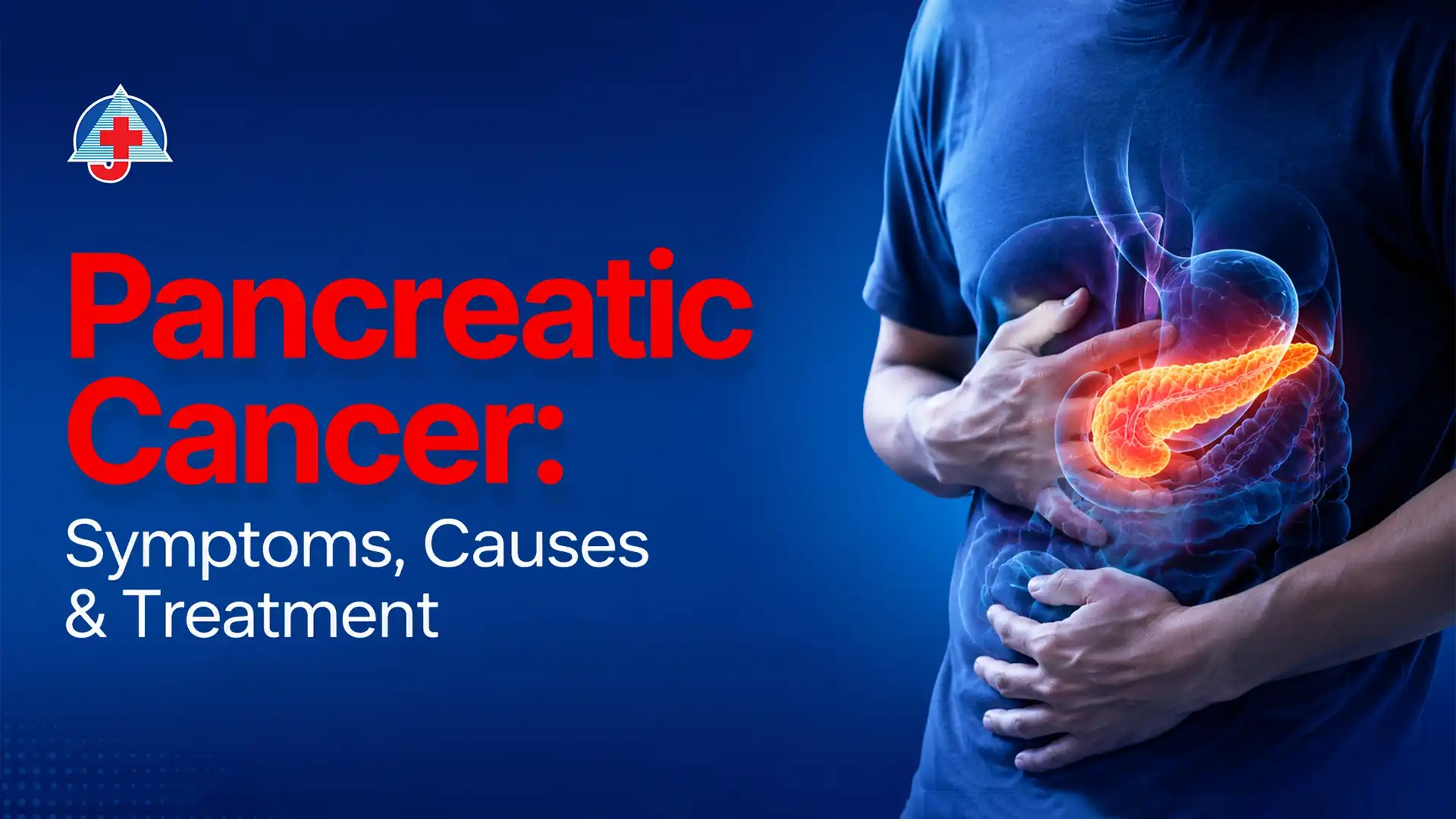
Pancreatic Cancer: Symptoms, Causes & Treatment
Pancreatic cancer is one of the most serious cancers we treat, partly because it often hides until it is advanced. Many people first notice that something is wrong when their skin or eyes turn yellow or when they lose weight without trying. By then, the disease may already have grown.
There were around 510,000 new cases of pancreatic cancer worldwide in 2022 and the numbers are rising in India. The encouraging news is that when the cancer is found while it is still confined to the pancreas, the five-year survival rate is close to 44%, compared with about 12% when it is found late. Early action changes everything.
At A.J. Hospital & Research Centre in Mangalore, our cancer team helps patients across Karnataka and Kerala spot the warning signs and access modern treatment. This guide explains pancreatic cancer symptoms, causes, diagnosis and treatment in plain language.
What is pancreatic cancer?
Pancreatic cancer is a growth that starts when cells in the pancreas multiply out of control. The pancreas lies deep in the abdomen and controls digestion and blood sugar. Because tumours here are hard to detect early, knowing the warning signs is vital.
Key takeaways
-
Pancreatic cancer is often found late because early symptoms are mild and easy to miss.
-
Painless jaundice, unexplained weight loss, back pain and sudden diabetes are key warning signs.
-
A CT scan, MRI, endoscopic ultrasound and biopsy confirm the diagnosis and stage.
-
Treatment may combine surgery, chemotherapy such as FOLFIRINOX and radiation therapy.
-
The Whipple procedure and distal pancreatectomy are the main surgical operations.
-
Found early, the five-year survival rate is far higher, so prompt action matters.
-
AJ Hospital, Mangalore, offers complete diagnosis, surgery and chemotherapy under one roof for patients across Karnataka and Kerala.
Why pancreatic cancer is called a silent cancer
Pancreatic cancer earns its difficult reputation because it rarely announces itself early. The pancreas sits deep in the abdomen behind the stomach, so a small tumour cannot be seen or felt during a normal examination.
Early symptoms are also vague. Mild tummy discomfort, a little weight loss or slightly oily stools are easily mistaken for common problems such as acidity or indigestion. People often treat these at home for weeks before seeking help.
By the time stronger symptoms appear, the cancer has frequently grown or spread. This is why awareness of the early signs of pancreatic cancer matters so much.
Understanding the pancreas
The pancreas is a soft organ about 15 cm long with 2 main jobs.
Its exocrine function makes enzymes that break down food. Without them, the body cannot absorb fat and nutrients well, which is why some patients notice oily stools or weight loss.
Its endocrine function makes hormones such as insulin that control blood sugar. When this part is affected, blood sugar can rise and diabetes may appear.
Because the pancreas sits close to the bile duct, liver, stomach and major blood vessels, a tumour here can affect digestion, blood sugar and bile flow at once.
Why is early detection difficult?
Unlike breast or cervical cancer, there is no routine screening test for the general public. Screening is advised only for people at high risk, such as those with a strong family history.
Symptoms appear late and the deep position of the pancreas means tumours cannot be felt by touch. Doctors, therefore, rely on patients reporting unusual or persistent symptoms early.
Symptoms of pancreatic cancer
Most early pancreatic cancer symptoms are mild, which is exactly why they are missed. See a doctor if any of the following last more than a week or two.
The absence of pain does not mean there is no problem. A painless symptom can be the most important warning of all.
|
Symptom |
What it may look like |
Why it matters |
|
Jaundice |
Yellow skin and eyes, dark urine, pale stools and itching |
A tumour may be blocking the bile duct |
|
Unexplained weight loss |
Losing weight without changing diet or activity |
Can signal cancer affecting digestion |
|
Abdominal pain |
A dull ache in the upper tummy that comes and goes |
The tumour may be pressing on nearby nerves |
|
Back pain |
An ache spreading from the tummy to the middle of the back |
Often linked to tumours in the body of the pancreas |
|
Loss of appetite |
Feeling full quickly or no longer wanting food |
Common as the disease progresses |
|
New onset of diabetes |
Diabetes appearing suddenly after age 50 with no clear cause |
The pancreas controls blood sugar |
|
Fatigue and weakness |
Constant tiredness that rest does not relieve |
The body is under strain from the disease |
Why jaundice can be a warning sign of pancreatic cancer
Jaundice is one of the most recognisable signs of pancreatic cancer, especially when a tumour grows in the head of the pancreas.
The bile duct carries bile from the liver to the intestine and it passes right through the head of the pancreas. When a tumour blocks this duct, bile cannot drain. It builds up in the blood and turns the skin and the whites of the eyes yellow.
You may also notice dark urine, pale stools and itchy skin. Painless jaundice in particular should never be ignored.
If you or a loved one develops yellowing of the skin or eyes, please seek medical help straight away. Jaundice has many causes, but it always needs prompt investigation.
Risk factors for pancreatic cancer
Pancreatic cancer develops when cells in the pancreas change and grow out of control. Some risk factors can be changed and some cannot.
Having a risk factor does not mean you will get pancreatic cancer. It simply means that staying alert to symptoms and looking after your health is worthwhile.
|
Risk factor |
Type |
How it raises risk |
|
Smoking |
Modifiable |
One of the strongest causes, roughly doubling the risk |
|
Alcohol |
Modifiable |
Heavy drinking can lead to chronic pancreatitis |
|
Obesity |
Modifiable |
Excess body weight is linked to a higher risk |
|
Diabetes |
Partly modifiable |
Long-standing diabetes is associated with the disease |
|
Family history |
Non-modifiable |
A close relative with cancer raises your risk |
|
Chemical exposure |
Partly modifiable |
Certain workplace chemicals may contribute |
|
Unhealthy diet |
Modifiable |
Diets high in red and processed meat may add risk |
|
Chronic pancreatitis |
Partly modifiable |
Long-term inflammation damages pancreatic cells |
How doctors diagnose pancreatic cancer
If pancreatic cancer is suspected, your doctor will arrange advanced diagnostics to confirm it and to see how far it has spread. Diagnosis is usually a step-by-step process.
-
Blood tests check your general health, liver function and a marker called CA 19-9 that can be raised in pancreatic cancer.
-
A CT scan is often the first detailed imaging test and shows the size and position of any tumour.
-
An MRI gives further detail of the pancreas, the bile ducts and the surrounding tissue.
-
Endoscopic ultrasound passes a thin probe through the mouth to take very close images and can also collect a tissue sample.
-
A biopsy removes a small piece of tissue for examination under a microscope and is the only way to confirm cancer with certainty.
Accurate diagnosis guides the treatment plan, so complete every test your doctor recommends.
Treatment options for pancreatic cancer
Pancreatic cancer treatment depends on the stage of the disease, the location of the tumour and your overall health. Most patients are cared for by a team rather than a single doctor.
Surgery aims to remove the tumour completely and offers the best chance of a cure when the cancer is caught early.
Chemotherapy uses medicines to kill cancer cells. It may be given before surgery to shrink a tumour, after surgery to lower the chance of return or as the main treatment in advanced disease. A regimen known as FOLFIRINOX is a standard chemotherapy option for suitable patients.
Radiation therapy uses high-energy beams to target cancer cells and is sometimes combined with chemotherapy.
Our multidisciplinary cancer care brings surgeons, oncologists, radiologists and dietitians together so that every decision is made with the full picture in mind.
Surgical treatment for pancreatic cancer
Surgery is the only treatment that can remove pancreatic cancer completely. The type of operation depends on where the tumour sits within the pancreas.
-
Whipple procedure
The Whipple procedure, also called pancreaticoduodenectomy, is used when the tumour is in the head of the pancreas.
The surgeon removes the head of the pancreas along with part of the small intestine, the gallbladder and part of the bile duct. The remaining organs are then reconnected so that digestion can continue.
It is a major operation and recovery takes time. Most patients stay in the hospital for one to two weeks. Performed by an experienced team, it offers many patients a real chance of a cure.
-
Distal pancreatectomy
A distal pancreatectomy is performed when the tumour is in the body or the tail of the pancreas.
In this operation, the surgeon removes the left part of the pancreas and often the spleen. The head is left in place, so digestion is usually less affected than after a Whipple procedure and recovery is often quicker.
-
Whipple procedure vs distal pancreatectomy
|
Feature |
Whipple procedure |
Distal pancreatectomy |
|
Tumour location |
Head of the pancreas |
Body or tail of the pancreas |
|
Organs removed |
Pancreas head, part of the intestine, gallbladder and part of the bile duct |
Left pancreas and often the spleen |
|
Complexity |
Higher, as reconnection is needed |
Lower, with no reconnection of the intestine |
|
Recovery |
Usually longer |
Usually shorter |
Robotic surgery and minimally invasive care
Pancreatic surgery is increasingly performed using minimally invasive and robotic techniques rather than one large open incision.
These approaches use several small cuts instead of one big one, which can mean less blood loss, less pain and a faster return home. Robotic systems also give greater precision near delicate blood vessels.
Not every patient is suitable and the decision is always based on safety first. At A.J. Hospital & Research Centre, our surgical gastroenterology team assesses each case to choose the safest, most effective approach.
Pancreatic cancer care at A.J. Hospital, Mangalore
For patients in Mangalore, coastal Karnataka and northern Kerala, A.J. Hospital & Research Centre offers complete pancreatic cancer care under one roof. Our care stands out in several ways.
-
A dedicated surgical gastroenterology team experienced in complex pancreatic operations, including the Whipple procedure and distal pancreatectomy.
-
Advanced diagnostics with CT, MRI, endoscopic ultrasound and biopsy for accurate staging.
-
Minimally invasive and robotic surgery capabilities for suitable patients.
-
Multidisciplinary cancer care that brings surgeons, oncologists and support staff together.
-
Experienced specialists and nursing teams who guide you through every stage.
-
Dietary and emotional support to help you stay strong through treatment.
Patients travelling from Kerala and across Karnataka for pancreatic cancer treatment in Mangalore are supported from the first consultation through to recovery.
When should you see a doctor
The table below shows signs that deserve timely medical attention.
|
Symptom |
Why it matters |
When to seek attention |
|
Yellow skin or eyes |
May mean a blocked bile duct |
Straight away |
|
Unexplained weight loss |
Can signal an underlying illness |
Within a week |
|
Persistent upper tummy or back pain |
May point to a pancreatic problem |
If it lasts more than a week |
|
Sudden diabetes after age 50 |
Can be linked to the pancreas |
Promptly at your next visit |
|
Loss of appetite with tiredness |
Common in many cancers |
Within a week or two |
If you have several of these signs together, please arrange a check soon.
Myth vs fact
Misunderstandings about pancreatic cancer can cost valuable time. Here are some common ones.
|
Myth |
Fact |
|
Pancreatic cancer has no symptoms |
It often has subtle early signs such as weight loss, back pain and jaundice that are easy to overlook |
|
Jaundice only means liver disease |
Jaundice can also be caused by a pancreatic tumour blocking the bile duct |
|
Pancreatic cancer cannot be prevented |
You cannot remove every risk, but not smoking, a healthy weight and limited alcohol consumption lower your chances |
|
Only smokers get pancreatic cancer |
Smoking is a major risk, yet non-smokers can develop it too |
Frequently Asked Questions
Early signs include unexplained weight loss, upper tummy or back pain, loss of appetite, jaundice and new-onset diabetes. These are often mild and easy to miss. Any symptom that lasts more than a week or two should be checked.
It can be difficult because there is no routine screening for the general public and symptoms appear late. However, prompt investigation of warning signs such as painless jaundice can lead to an earlier diagnosis and better outcomes.
There is no single cause. Smoking, obesity, heavy alcohol use, long-standing diabetes, chronic pancreatitis and a family history of the disease all raise the risk. Many cases occur in people over 60.
In most people, it is not, but in a small share of cases run in families. If two or more close relatives have had pancreatic cancer, tell your doctor, who may advise specialist assessment.
The Whipple procedure is a major operation to remove a tumour in the head of the pancreas. The surgeon removes the pancreas head, part of the intestine, the gallbladder and part of the bile duct, then reconnects the digestive system.
You cannot prevent every case, but you can lower your risk. Stopping smoking, keeping a healthy weight, limiting alcohol and eating a balanced diet all help to protect the pancreas.
Sometimes. Because the pancreas controls blood sugar, a tumour can interfere with insulin and cause diabetes. New diabetes appearing suddenly after age 50 with no clear cause is occasionally an early clue.
See a specialist if you have persistent jaundice, ongoing upper tummy or back pain, unexplained weight loss or sudden diabetes. Early specialist assessment gives you the best chance of timely treatment.
Conclusion
Pancreatic cancer is a serious disease, but knowing the symptoms and acting early can make a real difference. The warning signs of painless jaundice, unexplained weight loss, back pain and sudden diabetes deserve prompt attention rather than a wait-and-see approach.
With accurate diagnosis and modern pancreatic cancer treatment, including surgery, chemotherapy and multidisciplinary care, many patients can be helped and those diagnosed early have the best outcomes.
If you or someone you love has worrying symptoms, do not delay.
Book a consultation at A.J. Hospital & Research Centre, Mangalore
Speak to our surgical gastroenterology and oncology team about pancreatic cancer diagnosis and treatment for patients across Karnataka and Kerala. Book a consultation.
Call 0824 2225533 or 0824 2229333
NH-66, Kuntikana, Mangalore, Karnataka 575004
Medically reviewed
This article is intended for general education and is not a substitute for professional medical advice. It has been prepared for medical review by a qualified specialist at A.J. Hospital & Research Centre.
Trusted sources
World Health Organisation International Agency for Research on Cancer (GLOBOCAN), the American Cancer Society, the National Cancer Institute SEER programme and peer-reviewed medical literature.